
W-4 Calculator for Side Income: How Much Extra to Withhold
Have a job and side income from freelancing, gig work or a small business? Instead of sending the IRS quarterly payments, you can ask your employer to withhold a little more from each paycheck. This free W-4 calculator for side income works out how much to put in Step 4(c) of Form W-4 to cover the income tax and self-employment tax on your side income, or just enough to avoid the underpayment penalty.
Rules and figures this calculator uses
How to use the W-4 side income calculator
- Choose the tax year and your filing status.
- Enter your job details from your latest pay stub: your wages for the year, how often you're paid, the federal income tax withheld so far, and the amount taken from each paycheck.
- Check the paycheck counts. They're worked out from today's date. A new W-4 doesn't start at once, so the second number counts only the paychecks it will reach.
- Enter your side business profit for the whole year and any estimated tax you've already paid.
- Read the amount to put in Step 4(c), and open Show the math to see every step. Add last year's tax if you have it: the penalty target is often lower.
Why withholding beats quarterly payments for many side earners
- It's automatic. The tax comes out of each paycheck, so there's no due date to remember.
- It counts as paid evenly. The IRS treats withholding as paid in four equal parts on the due dates, whenever it was actually taken out. A bigger amount in the last months of the year also covers the earlier quarters, which a late estimated payment can't do.
- It covers self-employment tax too. Withholding is a payment toward your total tax, including the self-employment tax on your side profit.
The trade-off: if your side income stops, you have to hand in a new W-4 to stop the extra withholding.
Worked example
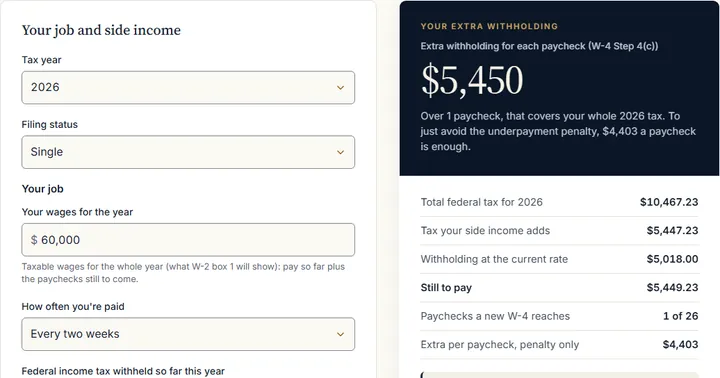
A single person earns a $60,000 salary, paid every two weeks, with $193 of federal income tax withheld from each paycheck. They expect $20,000 of side business profit in 2026 and hand in a new W-4 before the first paycheck of the year.
- Total federal tax: about $10,467, made up of $7,641 of income tax and $2,826 of self-employment tax.
- Withholding at the current rate: 26 × $193 = $5,018, which covers the salary but not the side income.
- Still to pay: $10,467 − $5,018 = $5,449.
- Extra per paycheck: $5,449 ÷ 26 = $209.59, so $210 in Step 4(c).
- Penalty only: 90% of this year's tax is $9,421, which needs $170 a paycheck. With $5,018 + 26 × $170 = $9,438 withheld, they'd still owe about $1,029 when filing, but no penalty.
How to fill in Form W-4 for side income
- Get a new Form W-4 from your employer or payroll app, or download it from IRS.gov.
- Fill in Step 1 and sign Step 5. Keep Steps 2 to 4(b) as they were.
- Enter the calculator's amount in Step 4(c), Extra withholding. If your old W-4 already had an amount there, add the two together.
- Give it to your employer, not the IRS. Your employer has until the first payroll period ending 30 or more days after you hand it in.
- Check your next pay stubs, and hand in a new W-4 in January, so the extra matches a full year.
Step 4(a) or Step 4(c)?
Step 4(a), "Other income", is meant for income such as interest and dividends. It raises withholding at your income tax rate, but it doesn't add self-employment tax, so for side business profit it usually withholds too little. Step 4(c) takes a plain dollar amount from every paycheck, which is easier to get right with this calculator. The IRS's own Tax Withholding Estimator works the same way.
Frequently asked questions
Do I still need to make quarterly estimated payments?
Not if your withholding covers enough. Publication 505 says you may be able to avoid estimated tax by asking your employer to take more tax out of your earnings. You owe no underpayment penalty if withholding plus on-time payments reach 90% of this year's tax or 100% of last year's (110% if last year's AGI was over $150,000), or if you owe less than $1,000 after withholding.
It's late in the year. Is it too late?
Often not. Because withholding counts as paid evenly through the year, a larger amount from your last paychecks can still cover earlier due dates. If no paycheck is left in time, pay the rest as an estimated payment by January 15, or see the Underpayment Penalty Calculator.
Does this include state tax?
No, federal tax only. Most states have their own withholding form.
What if my side income changes during the year?
Run the calculator again with the new figure and hand in a new W-4. You can change it as often as you need to.
Related tools
- 1099 Tax Calculator: the tax on your side income on its own.
- Quarterly Estimated Tax Calculator: if you'd rather pay quarterly.
- Underpayment Penalty Calculator: what you owe if you've already fallen short.