
IRS Underpayment Penalty Calculator (Form 2210)
Paid your quarterly estimated tax late, or too little? This free underpayment penalty calculator works out what the IRS is likely to charge, due date by due date. It follows the Form 2210 method: the safe harbor, payments credited to the oldest shortfall first, and the IRS rate for each period. Your numbers stay in your browser.
Rules and figures this calculator uses
How to use the underpayment penalty calculator
- Choose the tax year and your filing status.
- Enter your total tax for the year: the "total tax" line on Form 1040, minus refundable credits. If you haven't filed yet, estimate it with the 1099 Tax Calculator. Add any federal income tax withheld from a job.
- Enter last year's tax and AGI. They decide the safe harbor, which is often the cheaper target.
- List your estimated payments with the dates you really paid. The four due dates are filled in for you; change or remove them to match your bank records.
- Add what you paid with your return, if anything, and the date. Then read the penalty for each due date, and open Show the math to see every step.
How the IRS works out the penalty
- Required annual payment. The smaller of 90% of this year's tax or 100% of last year's tax. If last year's adjusted gross income was over $150,000 ($75,000 married filing separately), it's 110% of last year's tax.
- Four installments. A quarter of that amount is due on each due date: April 15, June 15, September 15 and January 15. When a date falls on a weekend or holiday, paying on the next business day counts as on time.
- Oldest first. Every payment, including withholding, goes first to the oldest due date that is still short, even if you meant it for a later one. Withholding counts as paid in four equal parts on the due dates.
- Charged like interest. Each amount paid late is charged the IRS underpayment rate for each day it was late, until you paid it or until April 15 of the next year, whichever comes first.
The penalty is worked out separately for each due date, so you can owe it for an early quarter even if you caught up later, and even if you get a refund.
IRS underpayment rates for 2026
| Period | Rate |
|---|---|
| January to March 2026 | 7% |
| April to June 2026 | 6% |
| July to September 2026 | 7% |
| October to December 2026 | 7% |
| January to March 2027 | Not published yet |
The rate is the federal short-term rate plus 3 points, set by the IRS for each quarter (IRS quarterly interest rates). Until the IRS announces a new rate, the calculator uses the latest one and tells you so. As on the Form 2210 worksheet, the January rate covers January 1 to April 15.
Worked example
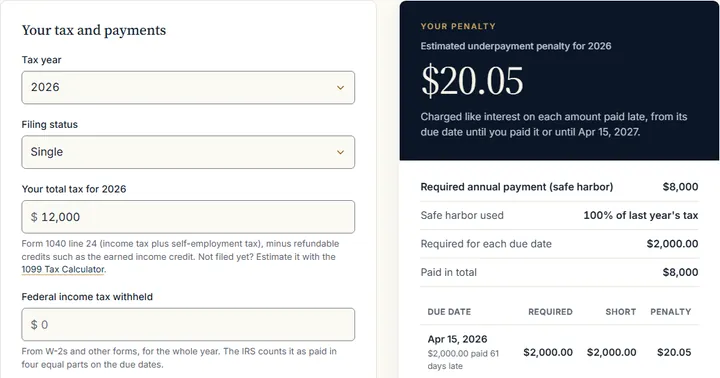
A single freelancer's total tax for 2026 is $12,000. Last year's tax was $8,000, with an AGI of $70,000, so the safe harbor is 100% of last year's tax: $8,000, or $2,000 for each due date.
They miss the April 15 payment and pay $4,000 on June 15, then $2,000 on September 15 and $2,000 on January 15, 2027.
- The June payment goes first to April's $2,000 shortfall. That $2,000 was paid 61 days late, all in the April to June period at 6%.
- The other $2,000 covers the June 15 installment on time, and September and January are on time too.
- Penalty: $2,000 × 61 ÷ 365 × 6% = $20.05.
They'll owe the remaining tax when they file, but the penalty is only for the April payment being late.
How to avoid or reduce the penalty
- Pay the safe harbor each quarter. A quarter of the required annual payment by each due date means no penalty, even if you owe more when you file. The Quarterly Estimated Tax Calculator works out the amounts.
- Pay late rather than never. The penalty grows each day, so paying a missed quarter now stops it for that amount.
- Use withholding if you also have a job. Withholding counts as paid evenly through the year, even if it was taken late in the year.
- The January exception. File your return and pay everything you owe by the end of January, and there's no penalty for the January installment.
- Uneven income. If most of your income came late in the year, the annualized income installment method on Form 2210 Schedule AI can lower or remove the penalty. This calculator doesn't use it yet.
- Waivers. The IRS can waive the penalty after a casualty, disaster or other unusual event, or if you retired after age 62 or became disabled and had a reasonable cause. You ask on Form 2210.
Does the IRS's automatic penalty relief remove it?
No. First Time Abate and the Automatic Exemption from Penalty, which began in summer 2026, cover penalties for filing late and paying late. They don't cover the estimated tax penalty. A past estimated tax penalty also doesn't count against you when the IRS checks your history for that relief (IRS administrative penalty relief).
Do I need to file Form 2210?
Usually not. The IRS works out the penalty and sends a bill. You must file Form 2210 with your return if you ask for a waiver, use the annualized income method, or count withholding on the dates it was actually taken.
Frequently asked questions
I paid everything by the time I filed. Can I still owe the penalty?
Yes. The penalty is for paying late during the year, so it's figured for each due date. Paying in full when you file stops it, but it doesn't remove the days that had already passed.
Can I owe the penalty and still get a refund?
Yes. If you paid most of your tax late in the year, you can be due a refund and still owe a penalty for the early due dates. The IRS takes it out of the refund.
Does the penalty keep growing after April 15?
The estimated tax penalty stops on April 15 of the next year. Tax still unpaid after the filing deadline is charged interest and a separate late payment penalty instead.
Why does a payment I made for June count toward April?
The law credits every payment to the oldest unpaid installment first, whatever you wrote on it. That's why one missed quarter can make later ones look short too.
Does this include my state's penalty?
No. This calculator covers the federal penalty only. Most states with an income tax have their own estimated tax rules and penalties.
Related tools
- Quarterly Estimated Tax Calculator: what to pay on each due date so this doesn't happen again.
- 1099 Tax Calculator: your total federal tax for the year.
- Income & Expense Tracker: keep your profit up to date through the year.