
1099 Tax Calculator (2026): Self-Employment & Federal Income Tax
Use this free 1099 tax calculator to see how much self-employment tax and federal income tax you'll owe on your freelance, contractor or gig income for 2026, and how much to set aside from each client payment. It needs no sign-up, and the numbers you enter are calculated on your device. We don't send them to our servers or store them.
Tax-year figures this calculator uses
How to use the 1099 tax calculator
- Choose the tax year and your filing status: the status you'll use on your return.
- Enter your 1099 / self-employment income for the year: everything clients and platforms paid you, including payments that didn't come with a 1099. Box 1 of each Form 1099-NEC is a good place to start.
- Enter your business expenses, the costs of running your business that go on Schedule C, such as software, equipment and business mileage.
- Add your state's income tax rate if you'd like a rough state figure too. It's optional and never changes the federal numbers.
- Open "Other income and payments" if you or your spouse also earn W-2 wages, or you've already paid federal tax this year. Tick "specified service" only if you work in a field such as consulting, law, accounting, health or financial services. It only matters at higher incomes.
- Read your result. It updates as you type: your total federal tax, how much to set aside from each client payment and your quarterly payment. Open Show the math to check every step, or download a PDF to keep.
How this calculator works
As a 1099 worker you pay two federal taxes on your profit: self-employment tax (your Social Security and Medicare, which an employer would normally split with you) and regular federal income tax. The calculator follows the same order as the IRS forms:
- Net profit: your 1099 income minus business expenses (Schedule C).
- Self-employment tax: 15.3% on 92.35% of net profit. The 12.4% Social Security part stops at the $184,500 wage base (shared with any W-2 wages); the 2.9% Medicare part has no limit (Schedule SE). If those net earnings are under $400, there's no self-employment tax.
- Half of self-employment tax is deductible when working out your adjusted gross income.
- Standard deduction for your filing status ($16,100 single or $32,200 married filing jointly for 2026).
- Qualified business income (QBI) deduction: up to 20% of your business profit (after the self-employment tax deduction), capped at 20% of taxable income. From 2026 there's a $400 minimum if you have at least $1,000 of QBI from a business you actively run.
- Federal income tax using the 2026 tax brackets, plus the 0.9% Additional Medicare Tax if your earnings are above $200,000 ($250,000 joint).
Open Show the math under your result to see every one of these steps with your own numbers.
Example: $60,000 of 1099 income
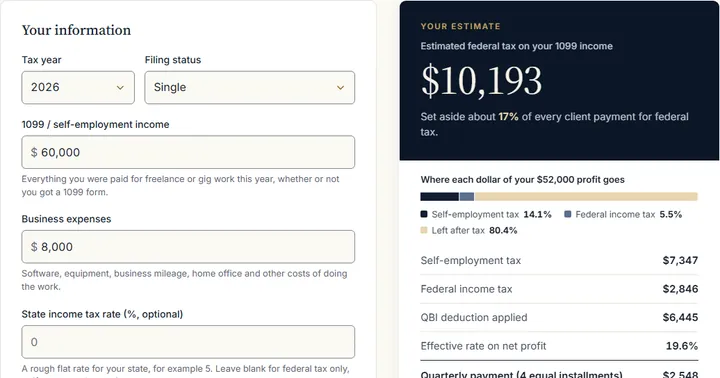
A single freelancer earns $60,000 from clients in 2026 and spends $8,000 on business expenses, with no other income.
| Net profit | $52,000 |
|---|---|
| Self-employment tax (15.3% × $48,022) | $7,347 |
| Adjusted gross income ($52,000 − $3,674) | $48,326 |
| Standard deduction | $16,100 |
| QBI deduction (capped at 20% of $32,226) | $6,445 |
| Taxable income | $25,781 |
| Federal income tax | $2,846 |
| Total federal tax | $10,193 |
That's about 17% of every client payment, or four quarterly payments of about $2,548. State income tax, if your state has one, would be extra. Enter your state's rate in the optional field to include a rough state estimate. With a 5% rate, for example, that's another $2,600, for a total of about $12,793.
What this estimate doesn't include
- Your state's actual tax rules. The optional state rate is a flat estimate on your net profit, so it doesn't follow your state's brackets, deductions or credits. Local income taxes aren't included.
- Tax credits (such as the Child Tax Credit or Earned Income Tax Credit) and itemized deductions.
- The extra standard deduction and the $6,000 senior deduction for people aged 65 or older.
- The self-employed health insurance deduction and retirement contributions (SEP-IRA, Solo 401(k)).
- Capital gains, dividends, rental income, Alternative Minimum Tax and the Net Investment Income Tax.
- Businesses that pay W-2 wages to employees or own significant equipment or property, which can change the QBI deduction at higher incomes.
Treat the result as a planning estimate, not tax, legal or financial advice. JAJPO does not prepare or file tax returns and is not affiliated with the IRS. For a final figure, use tax software or a qualified tax professional. See our Disclaimer and how we build and check our tools.
Frequently asked questions
How are 1099 taxes calculated?
Start with your net profit: 1099 income minus business expenses. Self-employment tax is 15.3% of 92.35% of that profit. Half of it is deducted, then the standard deduction and the QBI deduction, and federal income tax is worked out on what's left using the year's tax brackets. Your 1099 tax is the two taxes added together. The calculator follows these steps and lists each one under Show the math.
What is the self-employment tax rate for 2026?
15.3% of 92.35% of your net earnings, which works out to about 14.1% of your profit. It's made up of 12.4% for Social Security, on up to $184,500 of earnings in 2026, and 2.9% for Medicare, with no limit. Above $200,000 of earnings ($250,000 married filing jointly, $125,000 married filing separately), an extra 0.9% Additional Medicare Tax applies.
How much tax will I owe on 1099 income?
It depends on your profit, filing status and other income. In the example above, a single freelancer with $52,000 of profit and no other income owes about $10,193 of federal tax for 2026: $7,347 of self-employment tax and $2,846 of income tax. Enter your own numbers in the calculator to see yours.
Does this 1099 tax calculator include state income tax?
Only if you enter your state's rate in the optional field. It applies that flat rate to your net profit as a rough estimate and shows it separately, so the federal figures don't change. Real state rules differ, so check your state's tax agency for the exact amount.
How much should I set aside for taxes as a 1099 worker?
Many freelancers set aside 25–30% to be safe, but your real figure depends on your profit, filing status and other income. For federal tax alone, the example above works out to about 17%. Use the calculator for your own percentage, and enter your state's income tax rate in the optional field to include state tax.
Do I owe tax if I didn't get a 1099 form?
Yes. All self-employment income is taxable whether or not a client sends a 1099. For payments made in 2026, clients only have to send Form 1099-NEC once they pay you $2,000 or more, and payment apps send Form 1099-K above $20,000 and 200 transactions. Below those amounts the income is still taxable.
When are quarterly estimated taxes due?
For tax year 2026: April 15, June 15 and September 15, 2026, and January 15, 2027. You generally avoid an underpayment penalty if you pay at least 100% of last year's tax (110% if last year's adjusted gross income was over $150,000) or 90% of this year's.
What is the QBI deduction?
The qualified business income deduction lets most freelancers deduct up to 20% of their business profit from taxable income. It doesn't reduce self-employment tax. Below $201,750 of taxable income ($403,500 joint) for 2026, most freelancers get the full amount.
Is this calculator reviewed by a tax professional?
Not yet. Every figure comes from the official IRS and Social Security sources listed under the calculator, the method follows the IRS forms step by step, and the figures are re-checked whenever the IRS publishes new tax-year amounts. Because no professional has reviewed your personal situation, use the result as an estimate and confirm important decisions with a CPA, Enrolled Agent or tax software.
Related tools and guides
- Quarterly Estimated Tax Calculator: the minimum to pay each quarter to avoid an IRS penalty, using last year's tax.
- Freelance Hourly Rate Calculator: work backwards from the take-home pay you want to the rate you need.
- Income & Expense Tracker: total your income and expenses for the year, then send them here in one tap.
- Self-Employment Tax 2026 guide: how the 15.3% tax works, with worked examples.
- 1099 vs W-2 Calculator: compare contract work with a salaried job after tax and benefits.
- Gig Driver Tax Calculator: the same estimate built for rideshare and delivery drivers.
- Home Office Deduction Calculator: work out your home office deduction, then add it as a business expense here.
- Self-Employed Health Insurance Deduction Calculator: see how much your health premiums save, with the premium tax credit included.
- S-Corp Tax Savings Calculator: see if an S corp would lower your tax after payroll and running costs.
- Solo 401(k) / SEP-IRA Calculator: see how much you can put away and the income tax it saves.