
Self-Employed Health Insurance Deduction Calculator (2026)
Pay for your own health insurance as a freelancer? You can usually deduct the premiums, but the amount depends on your profit and on any Marketplace credit you get. This self-employed health insurance deduction calculator works out your 2026 deduction, handles the premium tax credit alongside it, and warns you if you're near the income limit. It's free, there's no sign-up, and your numbers stay in your browser.
Rates and rules this calculator uses
How to use the health insurance deduction calculator
- Enter your business income and expenses. Leave your health premiums out of expenses: they aren't a Schedule C expense.
- Say whether you or your spouse could have joined an employer's subsidized health plan. Months when you could have joined don't count, even if you didn't join.
- If you bought your plan through HealthCare.gov or a state Marketplace, enter the yearly premiums, the benchmark plan premium and the advance credit from columns A, B and C of Form 1095-A, plus your household size and where you live.
- If you didn't, enter your health, dental and vision premiums for you, your spouse and your dependents. Add long-term care premiums and ages if you have them.
- Open the optional section to add retirement plan contributions, your filing status, W-2 wages and other income. Retirement contributions lower the limit on this deduction.
- Read your result: your deduction, the federal income tax it saves and, for Marketplace plans, your premium tax credit. Open Show the math for each step, or download your estimate as a PDF.
How the deduction works
If you're self-employed and have a net profit, you can generally deduct what you pay for medical, dental and vision insurance and qualified long-term care insurance. It covers you, your spouse, your dependents, and your child who was under 27 at the end of the year, even if that child isn't your dependent. Medicare premiums you pay voluntarily can count too.
You don't need to itemize. The deduction goes on Schedule 1 (Form 1040), line 17, not on Schedule C. That has two effects:
- It lowers your income tax.
- It doesn't lower your self-employment tax. Your premiums aren't a business expense, so don't include them with your Schedule C costs.
For a sole proprietor, the policy can be in your name or your business's name. Most people can use the worksheet in the Form 1040 instructions. You must use Form 7206 if you have more than one source of self-employment income, you count long-term care premiums, or you file Form 2555.
The two limits
1. The deduction can't exceed your earnings from the business
The limit is your net profit, minus half of your self-employment tax, minus any self-employed retirement plan contributions from that business. If your profit is small, your deduction is small too. With no profit, there's no deduction.
2. You can't count months with employer coverage available
You can't deduct premiums for any month you could have joined a subsidized health plan from your employer or your spouse's employer. This applies even if you didn't actually join. The same goes for a subsidized plan from the employer of your dependent, or of your child under 27. The rule is applied separately to long-term care plans.
Premiums you can't deduct here may still count as medical expenses on Schedule A if you itemize. Don't count the same dollars twice.
Long-term care insurance limits for 2026
Premiums for a qualified long-term care contract count only up to a limit for each person, based on their age at the end of the year.
| Age at the end of 2026 | Limit per person |
|---|---|
| 40 or under | $500 |
| 41 to 50 | $930 |
| 51 to 60 | $1,860 |
| 61 to 70 | $4,960 |
| 71 or over | $6,200 |
Worked example: a plan outside the Marketplace
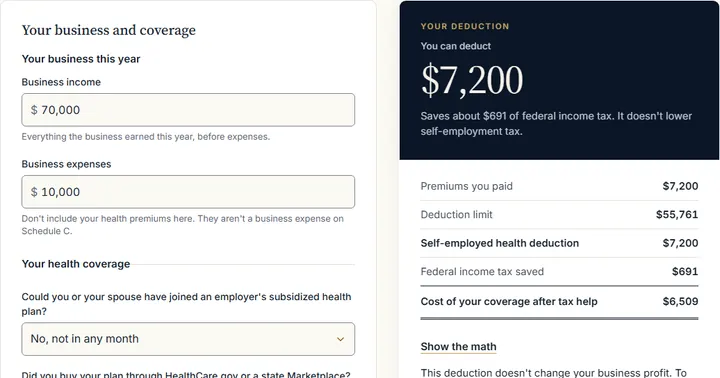
A single freelancer earns $70,000 in 2026 with $10,000 of business expenses, and pays $7,200 in health premiums. No employer plan is available to them.
| Net profit | $60,000 |
|---|---|
| Half of self-employment tax | −$4,239 |
| Deduction limit | $55,761 |
| Deduction (all $7,200 fits under the limit) | $7,200 |
| Federal income tax saved | $691 |
| Self-employment tax saved | $0 |
The saving is less than 12% of the premiums, even in the 12% bracket. A lower income also shrinks this freelancer's QBI deduction, so about 80% of the deduction reaches their taxable income.
If your plan is from the Marketplace
You can't deduct premiums that the premium tax credit paid for. But the deduction lowers your income, a lower income raises your credit, and a bigger credit leaves fewer premiums to deduct. Each number depends on the other.
The IRS gives two ways to solve this in Rev. Proc. 2014-41, repeated in Publication 974. This calculator uses the iterative method, repeating the steps until both numbers change by less than $1. If they never settle, it uses the shorter alternative calculation and tells you. Your deduction plus your credit can't be more than your premiums.
Worked example with a credit
A single freelancer in Ohio has $50,000 of net profit in 2026 and no other income. Their Marketplace plan costs $7,200 for the year, and the benchmark plan costs $7,800. They received $3,000 in advance credit.
| Household income before the deduction | $46,468 |
|---|---|
| Deduction | About $3,365 |
| Household income after the deduction | About $43,102 (275% of the poverty line) |
| Expected contribution at 9.2% | About $3,965 |
| Premium tax credit ($7,800 − $3,965) | About $3,835 |
| Extra credit due at filing ($3,835 − $3,000) | About $835 |
The deduction and the credit add up to the $7,200 premium, so every dollar is used once.
What changed for 2026: the credit cliff and full repayment
Two rules are tougher for 2026, and they matter most to freelancers, whose income moves around.
- The 400% limit is back. The temporary rule that allowed a credit above 400% of the poverty line ended with 2025. For 2026, household income of even $1 over the limit means no credit at all. For one person in the 48 states and DC, the limit is $62,600. For a household of four, it's $128,600.
- There's no cap on repayment. If your advance credit is more than your final credit, you repay all of the difference with your return. Earlier caps based on income no longer apply for 2026.
Two more 2026 changes affect fewer people. If you enroll through a special enrollment period that's based only on your expected income, that coverage doesn't qualify for the credit. If your income ends up under the poverty line, you qualify only if the Marketplace estimated it at 100% to 400% when you enrolled and paid advance credit.
When this page was last checked in November 2026, Congress hadn't extended the earlier rules. The 2026 poverty line figures come from the 2025 HHS guidelines. Alaska and Hawaii have higher figures, and the calculator handles them.
Near the limit? Your household income is based on your adjusted gross income, so the health deduction itself helps. So do other deductions that lower it, such as self-employed retirement contributions. Check your income through the year, and tell your Marketplace if it changes so your advance credit stays close to the right amount.
What if your income changes during the year?
With a Marketplace plan, the calculator adds an If your income changes table under your result. It shows your household income, your premium tax credit and what you'd repay or get back if your profit ends up $5,000 or $10,000 lower, or $5,000, $10,000 or $20,000 higher, keeping the advance credit you get now. It also tells you how much more profit you can make before your household income passes the 400% line, where the credit stops and every dollar of advance credit has to be paid back. It works this out with the health deduction and the credit solved together, as the IRS method does, so it's more than a straight-line guess.
Frequently asked questions
Can I deduct health insurance as a business expense on Schedule C?
No, not for yourself as a sole proprietor. It goes on Schedule 1 as an adjustment to income. That's why it doesn't reduce self-employment tax.
My spouse has a job with health benefits. Can I still claim this?
Not for any month you could have joined your spouse's subsidized plan, even if you chose not to.
I have a W-2 job and a side business. Does this work for me?
Only for months you couldn't join a subsidized plan through your job or your spouse's job. If you could, those months don't count.
Are dental and vision premiums included?
Yes. The deduction includes medical, dental and vision insurance. Enter those under "Other premiums" if they aren't part of your Marketplace plan.
What if I had no profit this year?
You can't take this deduction without a net profit, since the limit is based on your earnings from the business. If you itemize, your premiums may count as medical expenses instead.
I own an S corporation or I'm a partner. Can I use this calculator?
Not yet. Your premiums must be paid or reimbursed by the business and reported on your W-2 or Schedule K-1, and the limit works differently. See the Form 7206 instructions.
Are these the final 2026 rules?
Not quite. The 2026 Form 7206 and the 2026 Form 8962 instructions are still IRS early release drafts. The percentages and limits here come from Rev. Proc. 2025-25, Rev. Proc. 2025-32 and the tax code, and they match the credit table in the draft 2026 Form 8962 instructions. Your final Form 8962 could differ by a few dollars because of rounding, and because it works month by month if your coverage changes.
Related tools and guides
- 1099 Tax Calculator: your full federal tax estimate for the year.
- Quarterly Estimated Tax Calculator: what to pay the IRS each quarter.
- Home Office Deduction Calculator: compare the simplified and regular methods.
- 1099 vs W-2 Calculator: compare contract work with a job that includes benefits.
- Self-Employment Tax 2026 guide: how the 15.3% tax works.
- Solo 401(k) / SEP-IRA Calculator: retirement contributions can also lower your household income.