
1099 vs W-2 Calculator: Contract Rate or Salary?
Got a salaried offer and a contract offer, or thinking of going freelance? This 1099 vs W-2 calculator compares a W-2 job with 1099 contract work after taxes, health insurance and benefits, and shows the contract rate you'd need to come out even. It's free, there's no sign-up, and your numbers stay in your browser.
Tax figures this calculator uses
How to use the 1099 vs W-2 calculator
- Enter the job: the salary, what you'd pay toward the employer's health plan, the retirement match and any other benefits you'd actually use.
- Enter the contract: the hourly rate (or yearly amount), the hours and weeks you'd really be paid for, the health insurance you'd buy and your business expenses.
- Add your filing status and state rate under "Taxes" for a closer estimate.
- Read the result: which option leaves you better off, by how much, and the break-even contract rate. Open Show the math for every step, or download your comparison as a PDF.
Why a contract rate needs to be higher than a salary
Dividing a salary by 2,080 hours (40 hours × 52 weeks) gives its hourly equivalent, but a contractor charging that same rate ends up with less. As a contractor you:
- Pay both halves of Social Security and Medicare. Employees pay 7.65% and the employer pays another 7.65%. Contractors pay self-employment tax of 15.3% on most of their profit, although half of it is deductible for income tax.
- Aren't paid for time off. Holidays, vacation and sick days are paid in a salaried job. A contractor who takes 4 weeks off is paid for 48 weeks, not 52.
- Buy your own benefits. Health insurance, retirement savings and any other cover come out of your own pocket.
- Pay your own business costs: equipment, software, insurance, accounting and time spent finding the next client.
- Usually aren't covered by unemployment insurance or workers' compensation.
Contractors do get some tax breaks employees don't: business expenses, the self-employed health insurance deduction and the qualified business income deduction. The calculator includes all three.
Worked example
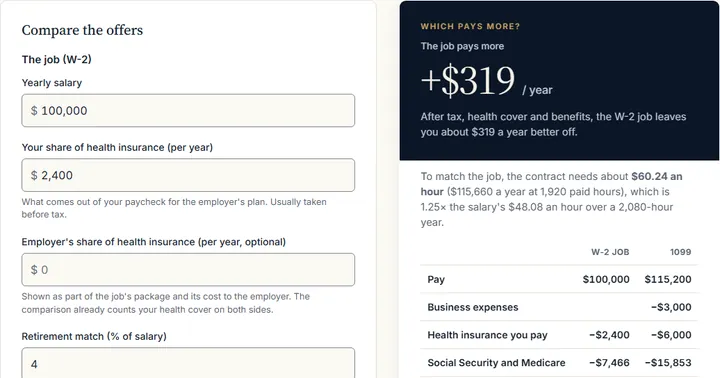
A single filer compares a $100,000 salary (they pay $2,400 a year toward the health plan, and the employer matches 4% into a 401(k)) with a $60-an-hour contract, 40 hours a week for 48 weeks, with $3,000 of business expenses and $6,000 a year for their own health insurance. Tax year 2026, no state income tax.
| W-2 job | 1099 contract | |
|---|---|---|
| Pay | $100,000 | $115,200 |
| Business expenses | −$3,000 | |
| Health insurance | −$2,400 | −$6,000 |
| Social Security and Medicare | −$7,466 | −$15,853 |
| Federal income tax | −$12,642 | −$9,175 |
| Take-home | $77,492 | $81,172 |
| Retirement match | +$4,000 | |
| Comparable value | $81,492 | $81,172 |
Although the contract pays $15,200 more, the job comes out about $319 a year ahead. The contract would need about $60.24 an hour to match it. That's 1.25 times the salary's $48.08 hourly equivalent. With more time off, higher costs or a bigger benefits package, the multiplier goes up. Many contractors aim for well above break-even, because contract work can end at short notice.
What the calculator assumes
- You take one or the other, not both at once. If you're married filing jointly, your spouse's wages set your tax brackets, but only the tax this job or contract adds is shown.
- Your share of the employer's health plan is taken before tax, as it is in most employer plans, so it's left out of Social Security, Medicare and income tax.
- As a contractor, you can deduct your health insurance premiums (up to your profit minus half of self-employment tax). This lowers income tax but not self-employment tax.
- The standard deduction is used, and federal tax uses the IRS brackets for the tax year you pick (2026 for now). State tax is the flat rate you enter.
- It doesn't include retirement plans you'd set up yourself (such as a SEP-IRA or Solo 401(k)), tax credits, or state unemployment and disability taxes.
Employee or contractor? It isn't your choice alone
Whether you're an employee (W-2) or an independent contractor (1099) depends on the facts of the working relationship, not on the job title or what the contract says. The IRS looks at three groups of evidence:
- Behavioral control: does the company control, or have the right to control, what you do and how you do it?
- Financial control: does the company control the business side of the work, such as how you're paid, whether expenses are reimbursed and who provides the tools?
- Type of relationship: are there written contracts or employee-type benefits, is the work expected to continue, and is it a key part of the company's business?
No single factor decides it. If it's unclear, either the business or the worker can ask the IRS to decide by filing Form SS-8. Workers who believe they were wrongly treated as contractors can use Form 8919 to pay only the employee's share of Social Security and Medicare on their wages. Labor laws and many states use their own tests, which can be stricter. Read the IRS guide: Independent contractor (self-employed) or employee?
Frequently asked questions
Is 1099 or W-2 better for taxes?
Neither is always better. Contractors pay more Social Security and Medicare tax, but they can deduct business expenses and health insurance and may get the qualified business income deduction. The calculator weighs all of these for your numbers.
How much more should a contractor charge than an employee?
A common rule of thumb is 25% to 50% more than the salary's hourly equivalent, depending on benefits, time off and business costs. Use the break-even rate above as your floor, then add a margin for slow periods.
How do I turn a salary into an hourly rate?
Divide the yearly salary by 2,080 (40 hours × 52 weeks). For example, $100,000 ÷ 2,080 = $48.08 an hour. That's the starting point, not the contract rate you need.
Do I pay quarterly taxes as a 1099 contractor?
Usually, yes. No tax is withheld from contract payments, so most contractors pay estimated tax four times a year. See the quarterly estimated taxes guide.
Related tools and guides
- Freelance Hourly Rate Calculator: work out a rate from the take-home pay you want.
- 1099 Tax Calculator: the full tax breakdown on contract income.
- Self-Employment Tax 2026 guide: how the 15.3% tax works.
- Quarterly Estimated Tax Calculator: what to pay the IRS each quarter.
- Self-Employed Health Insurance Deduction Calculator: see what your premiums really cost after the deduction and any credit.
- S-Corp Tax Savings Calculator: already earning well on contract? See if an S corp would help.
- Solo 401(k) / SEP-IRA Calculator: how much you can save for retirement on your own.