
QBI Deduction Calculator for 2026 (Section 199A)
Freelancers, sole proprietors and single-member LLC owners can deduct up to 20% of their business profit with the qualified business income (QBI) deduction. This free QBI deduction calculator works out your Section 199A deduction for 2026 or 2027: the 20% of QBI, the income limit, the phase-in above the threshold, the rules for specified service businesses and the new $400 minimum. Your numbers stay in your browser.
Rules and figures this calculator uses
How to use the QBI deduction calculator
- Choose the tax year and your filing status.
- Enter your net profit from Schedule C, and say whether your business is a specified service business (the list is below).
- Add your other income: wages from a job, your spouse's wages on a joint return, interest, and capital gains with qualified dividends. They don't count as QBI, but they set your taxable income, which decides the limits.
- Add the deductions that lower QBI: self-employed health insurance, retirement contributions and any qualified tips you deduct. If you have your return, you can type your taxable income before the QBI deduction instead of letting the calculator estimate it.
- Over the threshold? Add the W-2 wages your business paid and its property. Then read your deduction, and open Show the math for every step.
How the QBI deduction works
- Qualified business income. Your net profit minus the deductible part of self-employment tax, the self-employed health insurance deduction and retirement contributions for yourself. Wages, interest, dividends and capital gains aren't QBI, and from 2025 neither are tips you deduct under the new tips deduction.
- 20% of QBI. That's the starting point. Qualified REIT dividends add another 20% of their amount.
- The income limit. The deduction can't be more than 20% of your taxable income before the deduction, minus net capital gain and qualified dividends. For many freelancers this is the limit that bites, because the standard deduction comes off taxable income but not QBI.
- The threshold. At or under $201,750 of taxable income ($403,500 married filing jointly) for 2026, that's the whole calculation.
- Above the threshold. Across the next $75,000 ($150,000 joint), the deduction is gradually limited to 50% of the W-2 wages the business paid, or 25% of those wages plus 2.5% of its property. A specified service business also loses its deduction across the same range.
- The $400 minimum. From 2026, if you have at least $1,000 of QBI from businesses you materially participate in, the deduction is at least $400.
The deduction lowers your taxable income, so it saves income tax at your tax rate. It doesn't lower self-employment tax, and you get it whether you itemize or take the standard deduction.
QBI thresholds for 2026 and 2027
| Filing status | 2026 threshold | 2026 range ends | 2027 threshold |
|---|---|---|---|
| Single, head of household | $201,750 | $276,750 | $208,300 |
| Married filing jointly | $403,500 | $553,500 | $416,600 |
| Married filing separately | $201,775 | $276,775 | $208,325 |
The phase-in range is $75,000 ($150,000 joint) from 2026, up from $50,000 and $100,000. For 2027 the minimum deduction is $415, for at least $1,030 of QBI. Sources: Rev. Proc. 2025-32, Rev. Proc. 2026-35 and IRC section 199A.
Worked example
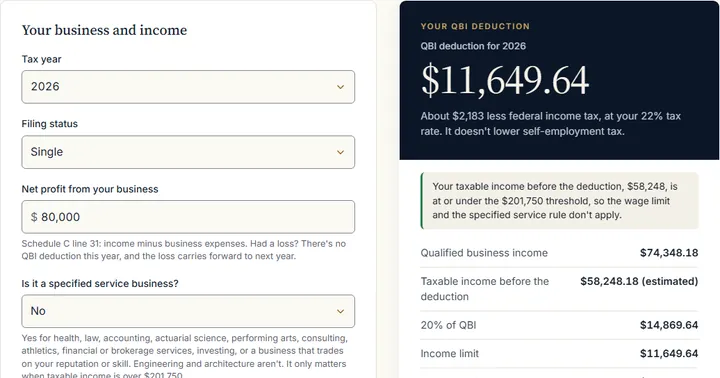
A single freelancer has $80,000 of net profit in 2026 and no other income.
- Self-employment tax: $80,000 × 92.35% = $73,880 × 15.3% = $11,303.64. The deductible half is $5,651.82.
- QBI: $80,000 − $5,651.82 = $74,348.18. That's also the adjusted gross income.
- Taxable income before the deduction: $74,348.18 − the $16,100 standard deduction = $58,248.18.
- 20% of QBI: $14,869.64.
- Income limit: 20% × $58,248.18 = $11,649.64.
- QBI deduction: the smaller, $11,649.64. It takes taxable income down to $46,598.54 and saves about $2,183 of federal income tax.
What is a specified service business?
A specified service trade or business (SSTB) is one in health, law, accounting, actuarial science, performing arts, consulting, athletics, financial services, brokerage services, investing and investment management, or trading and dealing in securities, partnership interests or commodities. It also covers a business whose main asset is the reputation or skill of its owners, such as earning endorsement or appearance fees. Engineering and architecture are left out by law.
It only matters when your taxable income is over the threshold. Below it, a specified service business gets the full deduction like any other. The final regulations (Treasury Regulation 1.199A-5) define each field; work that is mainly advice to clients can count as consulting.
Form 8995 or Form 8995-A?
If your taxable income before the QBI deduction is at or under the threshold, use the simpler Form 8995. Above it, use Form 8995-A, which applies the wage and property limit and the specified service rules business by business. Tax software picks the form for you.
Frequently asked questions
Is the QBI deduction permanent?
Yes. The law passed in July 2025 (Public Law 119-21) took away its end date, widened the phase-in range from 2026 and added the $400 minimum.
Do I have to itemize to get it?
No. You claim it on top of the standard deduction or your itemized deductions.
Does the QBI deduction lower self-employment tax?
No. Self-employment tax is figured on your net profit before any income tax deductions.
I run an S corporation. Do I get it?
Yes, on the profit that passes through to you, but not on the salary the corporation pays you, which is wages. The S-Corp Tax Savings Calculator takes the QBI deduction into account on both sides.
Why is my deduction less than 20% of my profit?
QBI is already lower than your profit, because half of self-employment tax and some other deductions come off it. Then the income limit uses taxable income after the standard deduction, which is often lower still.
Related tools
- 1099 Tax Calculator: your total federal tax for the year, with the QBI deduction built in.
- Solo 401(k) / SEP-IRA Calculator: retirement contributions lower QBI a little but taxable income more.
- Self-Employed Health Insurance Deduction Calculator: the figure for the health insurance box above.