
Mileage Deduction Calculator (2026): 72.5¢ and 76¢ Rates
Use this mileage deduction calculator to work out your 2026 business mileage deduction as a freelancer or gig worker. The IRS raised the rate partway through the year, and this calculator applies the right rate to each trip. Use quick totals or keep a free mileage log that stays in your browser.
Rates and rules this calculator uses
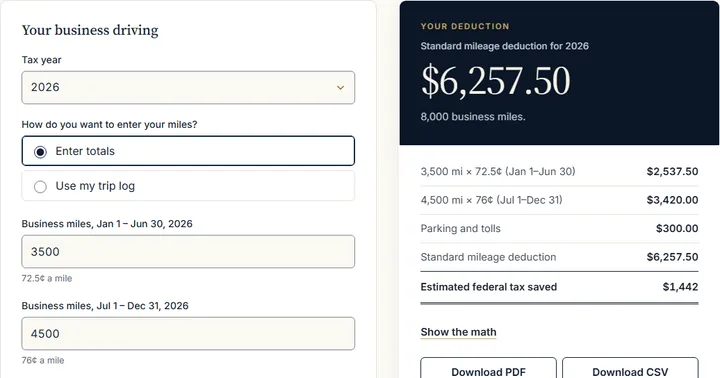
How to use the mileage deduction calculator
- Choose the tax year, then how you want to enter your miles.
- Enter totals: your business miles from January 1 to June 30 and from July 1 to December 31, so each part gets the right IRS rate. Or use the trip log: add each trip with its date, where and why you went, and the miles. The log is saved on this device.
- Add business parking and tolls. You can deduct these on top of the mileage rate.
- Compare with actual car expenses, if you like, by entering your total miles for the year and your total car costs.
- Estimate the tax you save by adding your business profit and filing status. This part is optional.
- Read your result: your standard mileage deduction and, if you filled them in, the actual-expense figure and the federal tax saved. Open Show the math for each step, or download your mileage report as a PDF.
The 2026 IRS mileage rate changed on July 1
The IRS set the 2026 business standard mileage rate at 72.5 cents a mile (Notice 2026-10). After fuel prices rose, it raised the rate to 76 cents a mile for driving on or after July 1, 2026 (Announcement 2026-11). So you need to split your 2026 business miles at June 30:
- Business miles from January 1 to June 30, 2026 × $0.725
- Business miles from July 1 to December 31, 2026 × $0.76
- Plus business parking fees and tolls
If you use the trip log, the calculator splits your trips by date for you.
Example: 8,000 business miles
A freelance designer drives 3,500 business miles from January to June and 4,500 from July to December 2026, and pays $300 in business parking and tolls. Their business profit before this deduction is $52,000, and they file as single.
| 3,500 miles × 72.5¢ | $2,537.50 |
|---|---|
| 4,500 miles × 76¢ | $3,420.00 |
| Parking and tolls | $300.00 |
| Mileage deduction | $6,257.50 |
| Federal tax saved (self-employment + income tax) | about $1,442 |
The deduction lowers both self-employment tax (about $884) and income tax (about $558). That's why tracking every business mile matters.
Which miles count?
- Count: driving to meet clients, to job sites, to buy supplies, to the bank or post office for your business, and between two work locations.
- Don't count: commuting. Driving from home to your regular workplace isn't deductible, however far it is.
- Home office exception: if your home office is your main place of business, trips from home to other work locations in the same business can be deductible.
- Temporary work locations: trips between home and a temporary work location (expected to last a year or less) can be deductible.
- Gig drivers: miles driven for deliveries and rides, and between them, are generally business miles. Personal errands in between aren't.
Standard mileage rate or actual expenses?
Instead of the mileage rate, you can deduct the business share of your actual car costs: gas, repairs, insurance, registration, lease payments and depreciation, multiplied by business miles ÷ total miles. Open Compare with actual car expenses in the calculator to see which is bigger. Some rules:
- For a car you own, you must use the standard mileage rate in the first year you use it for business if you ever want to use it for that car.
- For a leased car, if you use the mileage rate, you must use it for the whole lease.
- You can't use the mileage rate if you use five or more cars for business at the same time, or after claiming certain depreciation (such as Section 179 or bonus depreciation) on the car.
What to keep in your mileage log
The IRS can ask you to prove business mileage. For each trip, record the date, destination, business purpose and miles (or odometer readings), and note your total miles for the year. Record trips at the time, not from memory at tax time. Download your log from the calculator regularly as a backup.
What this calculator doesn't cover
- Depreciation calculations and limits for the actual-expense method. Enter your depreciation amount as part of car costs.
- Medical, moving and charitable mileage rates.
- W-2 employees: most can't deduct unreimbursed mileage on their federal return.
- State tax savings.
Treat the result as a planning estimate, not tax advice. See our Disclaimer and how we build and check our tools.
Frequently asked questions
What is the IRS mileage rate for 2026?
72.5 cents a mile for business driving from January 1 to June 30, 2026, and 76 cents a mile from July 1, 2026. The 2025 rate was 70 cents.
Can I deduct mileage and gas?
Not both. The standard mileage rate already covers gas, maintenance, insurance and depreciation. You can add business parking fees and tolls on top. If you'd rather deduct gas and other costs, use the actual-expense method instead.
Where do I claim the mileage deduction?
Self-employed people claim it on Schedule C (Form 1040) as car and truck expenses. It reduces both income tax and self-employment tax.
Is my trip log private?
Yes. Trips are saved only in your own browser and are never sent to JAJPO. That also means clearing your browser data deletes them, so download a copy regularly.
Is this calculator reviewed by a tax professional?
Not yet. The rates come from IRS Notice 2026-10 and Announcement 2026-11, and the rules from IRS Publication 463. Use the result as an estimate.
Related tools
- 1099 Tax Calculator: subtract your mileage deduction from business expenses to see your full tax.
- Quarterly Estimated Tax Calculator: what to pay the IRS each quarter.
- Freelance Hourly Rate Calculator: include your car costs in your rate.
- Income & Expense Tracker: record your mileage deduction alongside your other business expenses.
- Gig Driver Tax Calculator: drive for Uber, Lyft, DoorDash or Instacart? See your full tax estimate.
- Home Office Deduction Calculator: a qualifying home office can turn some commutes into business miles.